8 min read
Commercial use of drones in the EU
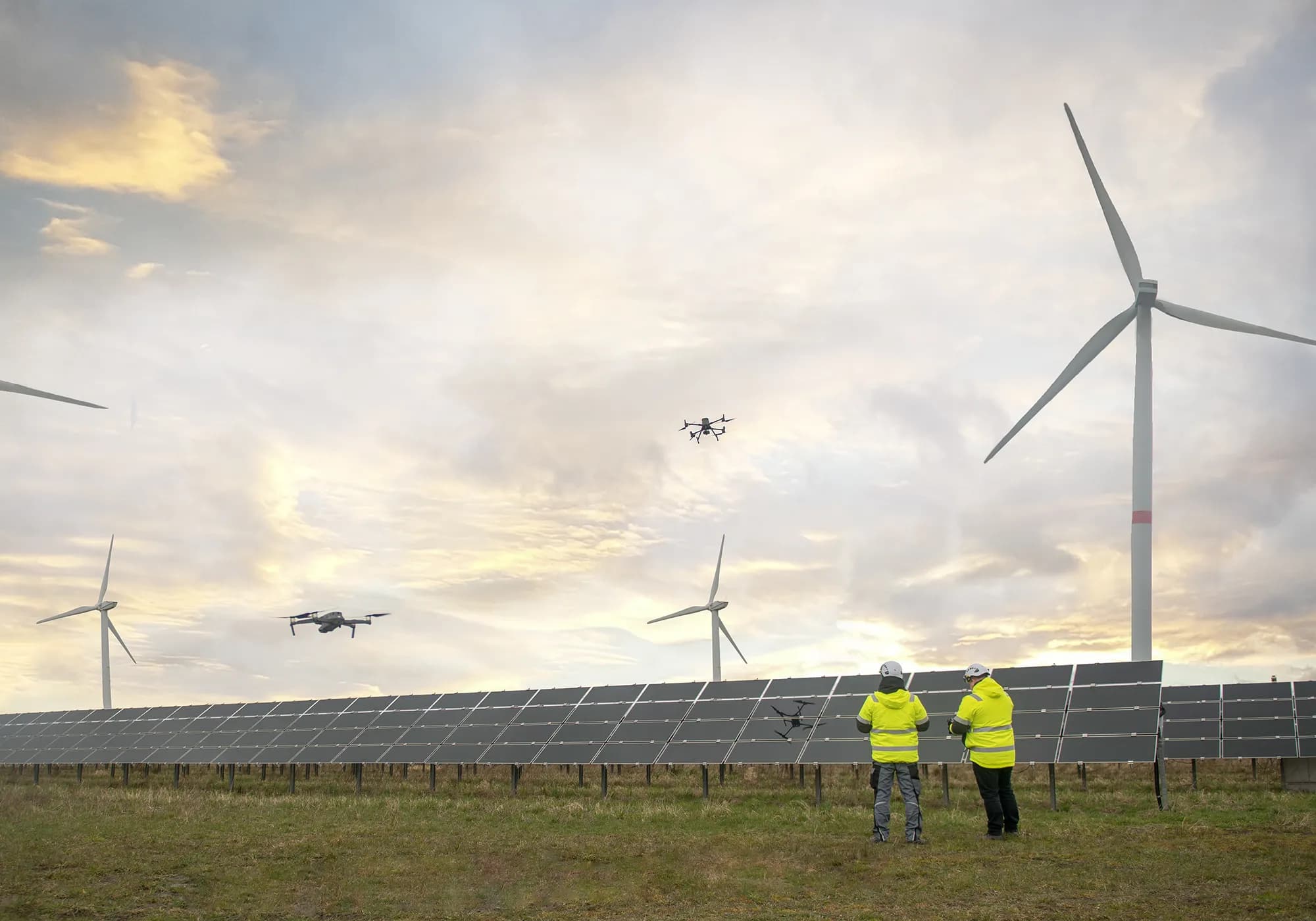
Drones have experienced a real boom in recent years. Many new business models rely on drone technology. These trends bring many drones to the sky — and new challenges in airspace.
The EU has responded to these trends with new regulations intended to increase safety. Drones are indispensable today: in inspection, acceptance, maintenance and upkeep they enable flexible, fast and cost-efficient processes.
EU Regulation (EU) 2019/947
Since 1 January 2021, a wide range of new requirements must be met when using drones — including for wind farm inspection — to remain legally compliant. The requirements stem from Europe-wide EASA regulation.
Many users assume it is enough to obtain an "EU drone licence" online and then be covered. That is not the case.
CE marking and classification
When purchasing, the drone must have CE marking and classification (C0–C4, risk or technical class) — only such products may be flown in European airspace.
The new regulations do not distinguish between private and commercial use. Instead, EU guidelines define three operating scenarios:
- OPEN — standard operations with defined limits
- SPECIFIC — extended operations with authorisation
- CERTIFIED — type-certification required systems
OPEN subcategories A1, A2, A3
A1
Flight near people is possible. No flight over outdoor gatherings and no flight directly over uninvolved persons.
A2
Flight only at a safe distance from uninvolved persons (minimum 30 metres; in exceptional cases with slow mode down to 5 metres).
A3
Flight far from people. No uninvolved persons may be present in the entire operational area. Minimum distance of 150 m from residential, commercial, industrial or recreational areas.
Assignment of drone models to A1–A3 follows from the drone class (risk class C0–C4).